
FLAC vs. WAV: Which Is Better for Audio Quality & Storage? (2026 Guide)
In the high-fidelity audio community, the FLAC vs. WAV debate is a long-standing classic. Whether you’re a seasoned audiophile, a studio producer, or a collector looking to reclaim disk space, you’ve likely asked the million-dollar question: “Which one is actually better?”
The Bottom Line: Making the Right Call
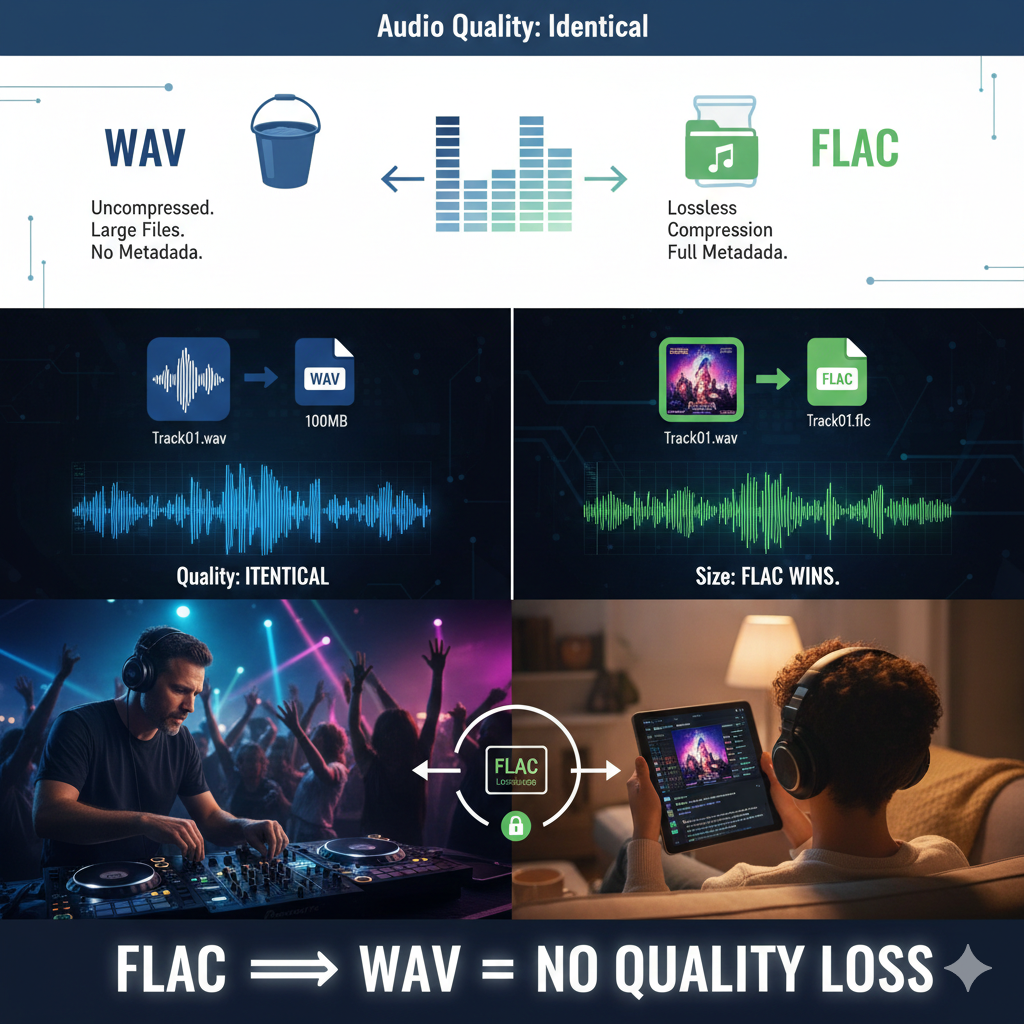
- For most listeners and collectors, FLAC is the clear winner. It offers bit-perfect quality with 50% less storage and superior organization.
- For professional studio tracking and legacy DJ hardware, WAV remains the industry standard. Its "raw" nature ensures zero CPU overhead and 100% plug-and-play reliability.
1. What’s the Difference? (The "Vacuum-Sealed" Analogy)
To understand the difference, imagine a wet sponge:
- WAV is like a soaking wet sponge in a bucket. It takes up massive space because it holds all the water (data) in its raw, uncompressed state.
- FLAC (Free Lossless Audio Codec) is like that same sponge, but vacuum-sealed. It’s significantly smaller and easier to store, but the moment you hit play, the file "unpacks" to deliver the exact same amount of water. No bits are left behind.
Comparison at a Glance
| Feature | WAV (Waveform Audio) | FLAC (Free Lossless) |
|---|---|---|
| Compression | Uncompressed (Raw) | Lossless Compression |
| File Size | 100% (Large) | 50% – 70% (Efficient) |
| Audio Quality | Bit-perfect (Original) | Bit-perfect (Identical) |
| Metadata (Tags) | Basic / Minimal | Excellent (Art, Lyrics, Bio) |
| Industry Standard | Recording & Mastering | Archiving & Audiophile Listening |
2. Audio Quality: Is 24-bit WAV "Heavier" Than FLAC?
A persistent myth claims that WAV sounds "airier" or "fuller" simply because the file size is larger. This is a misconception.
Because FLAC is a lossless codec, when your media player or high-end DAC opens a FLAC file, it reconstructs the audio bit-for-bit to match the original source.
The Verdict: In a rigorous double-blind A/B test—even on a world-class monitoring system—the two are sonically indistinguishable. A 24-bit/96kHz WAV and a 24-bit/96kHz FLAC contain the exact same digital information. Mathematically, they are clones.
3. Why Do DJs and Producers Still Cling to WAV?
If FLAC is smaller and sounds identical, why does the music industry remain obsessed with WAV?
- Zero CPU Latency: Since WAV is uncompressed, your computer doesn't have to "work" to decode the file. In a high-stakes DJ set with four decks or a studio session with 100+ tracks, WAV puts zero strain on the CPU, minimizing the risk of audio dropouts.
- Universal Ubiquity: From 1990s hardware to modern CDJs and obscure DAWs, every digital device reads WAV. While FLAC support is now standard in 2026, WAV remains the "fail-safe" format for legacy environments.
- Stability in Performance: For live sound and professional broadcasting, pros prefer the "raw" nature of WAV to eliminate even the microscopic risk of software decoding artifacts during a performance.
4. The Hidden Killer: Metadata and Organization
This is where FLAC truly outshines its rival.
If you’ve ever scrolled through a folder of WAV files labeled "Track 01," "Track 02" with no artist name or album art, you know the struggle. WAV was never designed to hold robust, standardized metadata.
FLAC supports ID3 and Vorbis comments perfectly. This means your high-resolution album art, artist biography, release year, and even synchronized lyrics stay embedded within the file. For anyone building a serious personal music library, FLAC is the only logical choice.
5. Can You Convert Between the Two?
Absolutely. You can convert FLAC to WAV and vice-versa as many times as you want without losing a single drop of quality. It’s like moving water between two different shaped glasses—the volume remains identical.
Tip: Many producers record in WAV but archive their finished masters in FLAC to save server space.
Final Verdict: Which Should You Choose?
Choose WAV if:
- You are recording or mastering music in a professional studio.
- You are a DJ performing on various club hardware (CDJs/Controllers).
- You have unlimited storage and want the most "raw" file possible for peace of mind.
Choose FLAC if:
- You are an audiophile listening on a high-end home system or DAP.
- You want to save 50% of your disk space without sacrificing a single bit of quality.
- You value a perfectly organized library with full metadata and album art.
🎧 Bring Studio Quality Everywhere
Whether you choose FLAC or WAV, you need a powerful local player to unlock their potential. Download iPlayer to experience true lossless audio on your iPhone.
Download iPlayerFrequently Asked Questions (FAQ)
Does Spotify use FLAC or WAV? As of 2026, Spotify HiFi (Supremium) primarily uses FLAC for its lossless tier, while its standard tiers use lossy Ogg Vorbis and AAC.
Is there a "more lossless" format? No. "Lossless" is binary—it either is or it isn't. Both WAV and FLAC are bit-perfect representations of the source audio.
Is FLAC the highest quality audio file? It is tied for the highest quality alongside WAV and AIFF.