
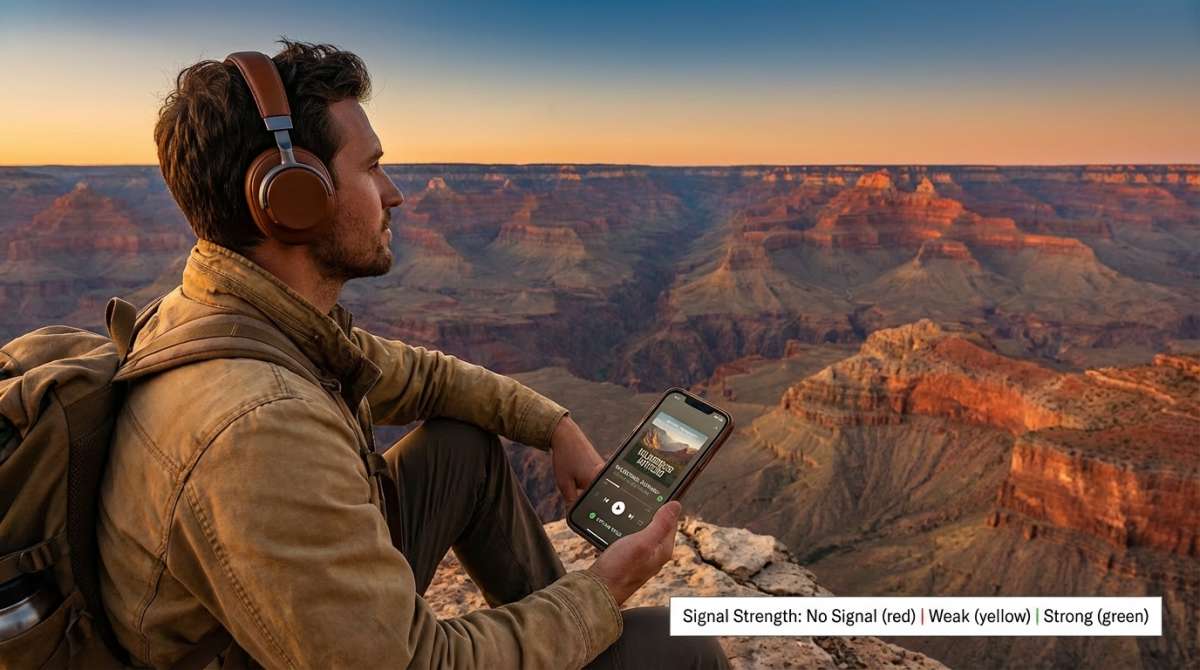
Why Local FLAC is the Ultimate Companion for America's Great Outdoors (2026 Guide)
Why Local FLAC is the Ultimate Companion for America's Great Outdoors (2026 Guide)
TL;DR
In signal blind spots like US National Parks, streaming services' "Offline Mode" often fails due to DRM verification. Local FLAC libraries offer Zero Network Dependency, Lossless Quality, and Permanent Ownership, making them the only reliable choice for outdoor adventurers. With a dedicated player like iPlayer, you can build a signal-free private music museum.
Last autumn, I stood in Badwater Basin, Death Valley, for ten whole minutes, just for one thing—to see if I could get a single bar of signal.
On my phone screen, the Spotify interface had been frozen for twenty seconds, with that little "Connecting..." text spinning endlessly. I had downloaded an offline playlist of over two thousand songs beforehand, but when I tapped on that Pink Floyd album, it told me: "Content temporarily unavailable." At that moment, I was about 40 miles from the nearest cell tower, at an elevation of -282 feet, standing at the lowest point in North America. Streaming's "Offline Mode" had fallen completely silent on this salt flat.
Back in the car, I opened a local FLAC file from my phone's music library. No buffering, no verification—the music started instantly, every detail crystal clear.
That moment, I understood: In America's great outdoors, true music freedom isn't about subscribing to Premium; it's about owning those files.
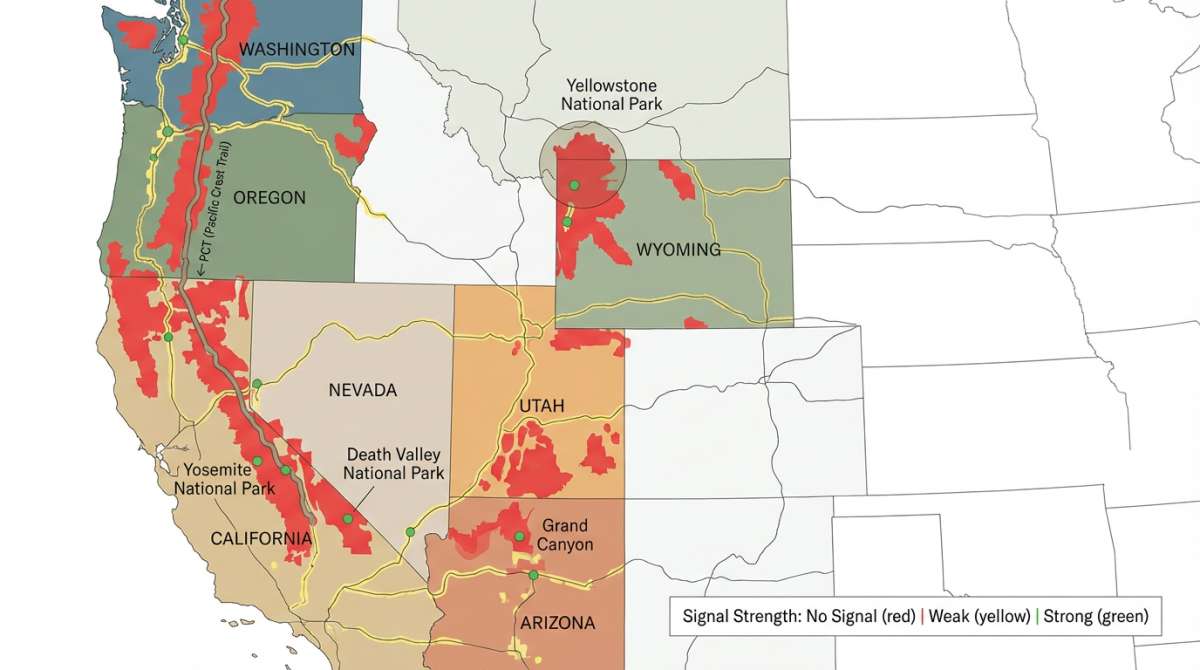 Network signal blind spots in major outdoor areas like PCT, Yellowstone, and Death Valley
Dead Zones Are the Norm
If you plan to visit America's great outdoor regions, you'd better accept this fact first: network dead zones are not occasional accidents; they are the norm.
In the High Sierra section of the PCT (Pacific Crest Trail), being completely out of contact for 4 to 10 consecutive days is standard procedure. You might only get a bar of signal when standing on a ridgeline with a line of sight to a nearby town. Yellowstone? Visitor centers like Old Faithful and Mammoth Hot Springs have signal, but once you enter the backcountry trails, it drops to zero immediately. Death Valley is even more direct—the vast majority of the park has no data signal at all.
Even Verizon, with the best performance, only provides coverage near highways and towns. But the charm of the great outdoors lies precisely in those places dozens of miles from the road—Bright Angel Trail in the Grand Canyon, Half Dome in Yosemite, Artist's Drive in Death Valley. In these places, a phone signal is a luxury.
Streaming services assume you can connect to the internet at any time. But in the American wilderness, this default assumption completely collapses.
The Hidden Trap of "Offline Mode"
Many people think downloading Spotify Premium offline playlists beforehand is enough. The problem is, streaming's "Offline Mode" isn't truly offline.
Spotify and Apple Music both have a hidden rule: you must go online at least once every 30 days. Why? Because of DRM encryption. What you downloaded isn't music files, but encrypted cache. The system needs to periodically connect to verify your subscription is valid; otherwise, the decryption key expires.
What does this mean? If you've been hiking the PCT for 10 days, and the 30-day mark arrives while you're deep in the High Sierra, all your offline playlists will lock up. They are physically in your phone, but unplayable.
Add to that device limits, library removals, and background auto-verification mechanisms—you aren't storing music, but a lease that requires a network to maintain. In the great outdoors, this lease can expire at any moment.
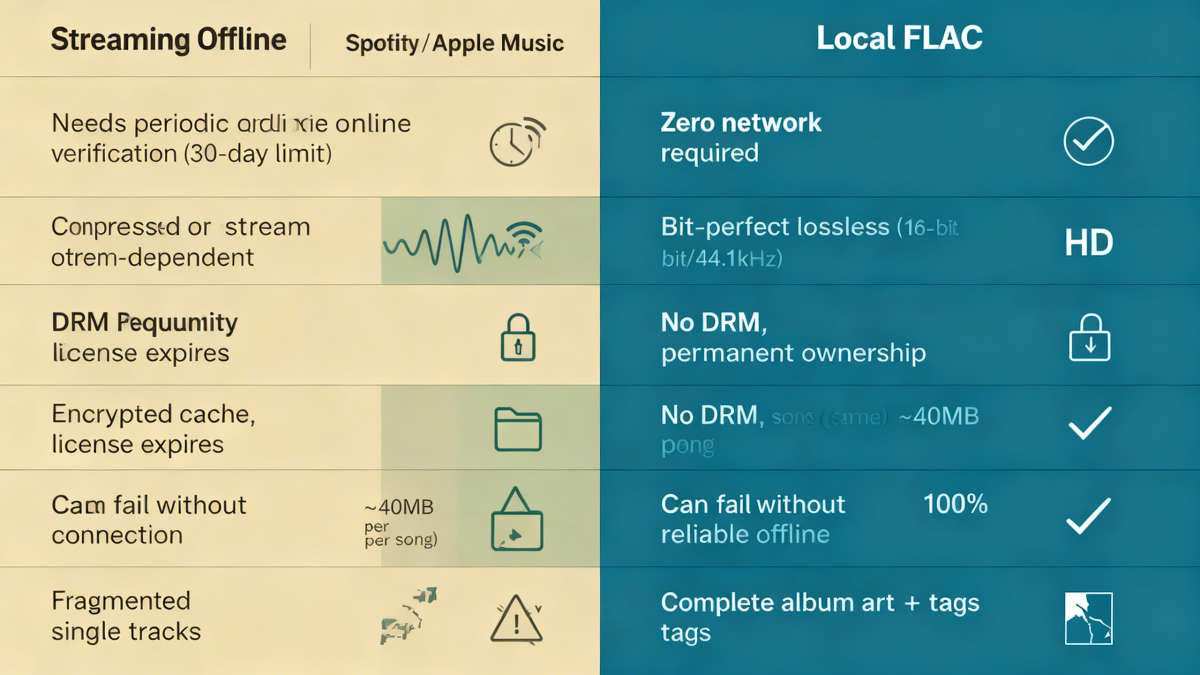 Comprehensive comparison of Streaming Offline vs Local FLAC: Network dependency, Sound quality, DRM limits, and Playback stability
Local FLAC vs Streaming Offline: In-Depth Comparison
To visualize the differences, we've created this comparison table:
| Feature | Local FLAC Library | Streaming (Spotify/Apple Music) Offline |
|---|---|---|
| Network Dependency | Zero (Requires no signal) | Periodic (Requires verification every ~30 days) |
| Ownership | Permanent (You own the files) | Leased (Invalid if subscription ends) |
| Sound Quality | Bit-Perfect Lossless (16-bit/44.1kHz+) | Lossy/Compressed (AAC/Ogg or transmission dependent) |
| DRM Restrictions | None (Transfer/Backup freely) | Heavy DRM (Locked to specific App) |
| Metadata | Fully Editable (Tags, Art, Lyrics) | Locked (System generated, unchangeable) |
| Reliability | 100% (Plays if battery exists) | Unstable (Can fail due to bugs or auth errors) |
Three Irreplaceable Advantages of FLAC
This is why, before every trip, I spend an evening copying selected albums into my phone—in FLAC format, stored locally.
1. Truly Offline
FLAC files have no DRM encryption and need no network verification. The moment you save it to your phone, it belongs to you. Whether you're on a ridge on the PCT or in a salt flat in Death Valley, as long as you have battery, you have music. No 30-day limit, no device limit, no background verification.
2. Lossless Sound Quality
FLAC is a lossless compression format; every PCM audio sample is preserved intact. Streaming "Lossless" is either master tapes uploaded after lossy compression (AAC/Opus) or suffers loss during transmission links. Local FLAC goes directly from phone storage to the DAC chip, with no intermediate loss. In the sunset of Yellowstone, under the stars of Yosemite, nature's purity deserves to be accompanied by the purest sound quality.
3. Complete Metadata and Album Art
Streaming offline cache is fragmented into single tracks. FLAC supports Vorbis Comment tags, embedding album art, artist info, and production year. When you organize your music library in your tent, you don't see a pile of nameless cache files, but an organized, aesthetic music world.
Storage Space: Not As Exaggerated As You Think
You might worry: "But aren't FLAC files huge? How many songs can a phone hold?"
The answer is: more than you think. A standard CD-quality FLAC song (16-bit/44.1kHz) is about 40MB. A 256GB phone, after deducting system and daily apps, leaves about 200GB for music. This means you can store about 5,000 songs. Even if you only allocate 100GB to music, that's two to three thousand songs—enough for any long-distance hike.
My strategy is: select 300-500 classic tracks, about 15-20GB. These songs cover all scenarios—light folk for morning wake-ups, rock for hiking, classical for dusk, and ambient music for stargazing. For outdoor travel, precision is more important than quantity.
Hiker enjoying music with a local FLAC library, free from network signal dependence
Frequently Asked Questions (FAQ)
Q: Why shouldn't I rely on streaming "downloads" outdoors?
A: Streaming downloads are encrypted caches that require periodic online DRM verification (usually every 30 days). During long hikes (like the PCT) or extended periods in dead zones, verification can fail, locking your library. App updates or bugs can also wipe offline content.
Q: What if my phone storage is full?
A: If space is tight, consider ALAC (Apple Lossless) or high-bitrate MP3 (320kbps) as a compromise. However, with most modern phones having 256GB+, storing hundreds of selected FLAC albums is rarely an issue. iPlayer users can also manage and delete listened tracks via Wi-Fi.
Q: Where can I download legal FLAC music?
A: We recommend Bandcamp (Indie artists), Qobuz Store (Mainstream Hi-Res), and NativeDSD (Audiophile quality). Check our detailed guide: 2026 FLAC Download Guide.
The Certainty of Ownership
I'm not saying streaming is bad. In the city, Spotify and Apple Music remain the most convenient choices. But in the American great outdoors, convenience gives way to certainty.
When you stand on a ridge on the PCT, or sit under the stars in Death Valley, what you need isn't a lease requiring network verification, but a music library that truly exists in your phone. It won't disappear because the network cuts out, won't lock because the subscription expired, and won't be taken down due to copyright issues.
It's right there, always there. That is the meaning of ownership.
🎧 Ready to Take Music on Your Adventure?
iPlayer is built for the offline experience, supporting FLAC/DSD lossless formats, letting your music bloom perfectly at any altitude.
- 🏔️ Zero Network Dependency: True local playback, rejecting DRM verification
- 🔋 Low Power Consumption: Optimized decoding engine for longer battery life on the trail
- 📂 WiFi Fast Transfer: One-click import of massive FLAC libraries before departure