
Don't Let Your Ears Be Displaced: Why I Advise You to Return to Local Music in 2026
Don't Let Your Ears Be Displaced: Why I Advise You to Return to Local Music in 2026
Summary (TL;DR)
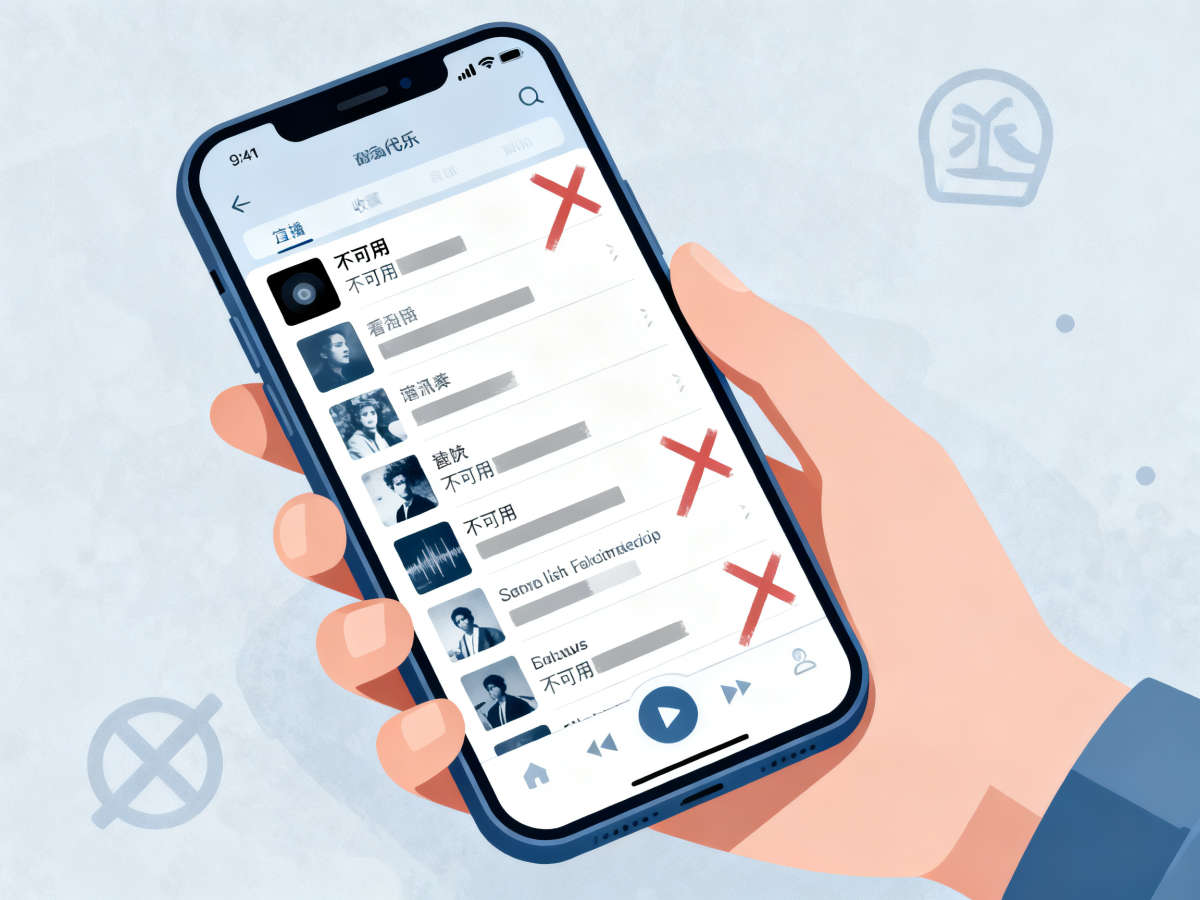
It's 2 AM. You put on your headphones, wanting to listen to that old song that accompanied you through countless nights. You open the streaming app, the song name is still in the playlist, but when you tap play, it's grayed out—"Song unavailable due to copyright request." In that moment, you suddenly realize: the music you thought you "owned" never belonged to you.
In the streaming era, we have infinite choices. For a small monthly fee, millions of songs are on standby. But when your carefully constructed playlist shatters overnight, when "lossless" quality always feels like it's missing something, when algorithmic recommendations become increasingly homogenized, you discover—we gained convenience, but lost true ownership.
In 2026, beneath the surface prosperity of streaming dominance, more and more people are quietly returning to local music. This isn't nostalgia; it's a sober choice.
1. The Three Traps of Streaming: What Are We Losing?
Trap 1: Copyright Takedowns, Your Playlist Can Turn "Gray" Anytime
On April 1, 2018, NetEase Cloud Music removed Jay Chou's entire catalog. This wasn't an April Fool's joke, but a real digital stripping. Countless users found that their collected favorites like "Qi Li Xiang," "Sunny Day," and "Nocturne" became invalid overnight. The platform's compensation plan was "buy 200 songs for 400 yuan," but that sense of deprivation could not be compensated by money.
This is not an isolated event. In 2015, the "Strictest Copyright Order" caused 16 platforms to take down millions of unauthorized songs in a month. In 2021, exclusive copyright agreements were broken, causing another reshuffle. Every copyright change is an earthquake for users' musical memories.
The core of the problem is that streaming is "rental." What you pay for is "access rights," not "ownership." When contracts between platforms and copyright holders expire, when business strategies adjust, or even due to an inadvertent takedown notice, your carefully collected playlist can turn gray in an instant. What you build on streaming services is like a palace built on quicksand.
Local music is different. It is stored permanently on your device, independent of platforms. Ten years, twenty years later, when you open that folder again, the song is still there, sounding as good as new.
Trap 2: Sound Quality Compromises, The Loss Chain Behind "Lossless"
Streaming platforms all promote their "lossless sound quality." Apple Music has Lossless, Tidal has HiFi. But when you really compare the streaming version of a song with a local FLAC file, the subtle differences—high-frequency extension, soundstage width, clarity of instrument separation—often tell another story.
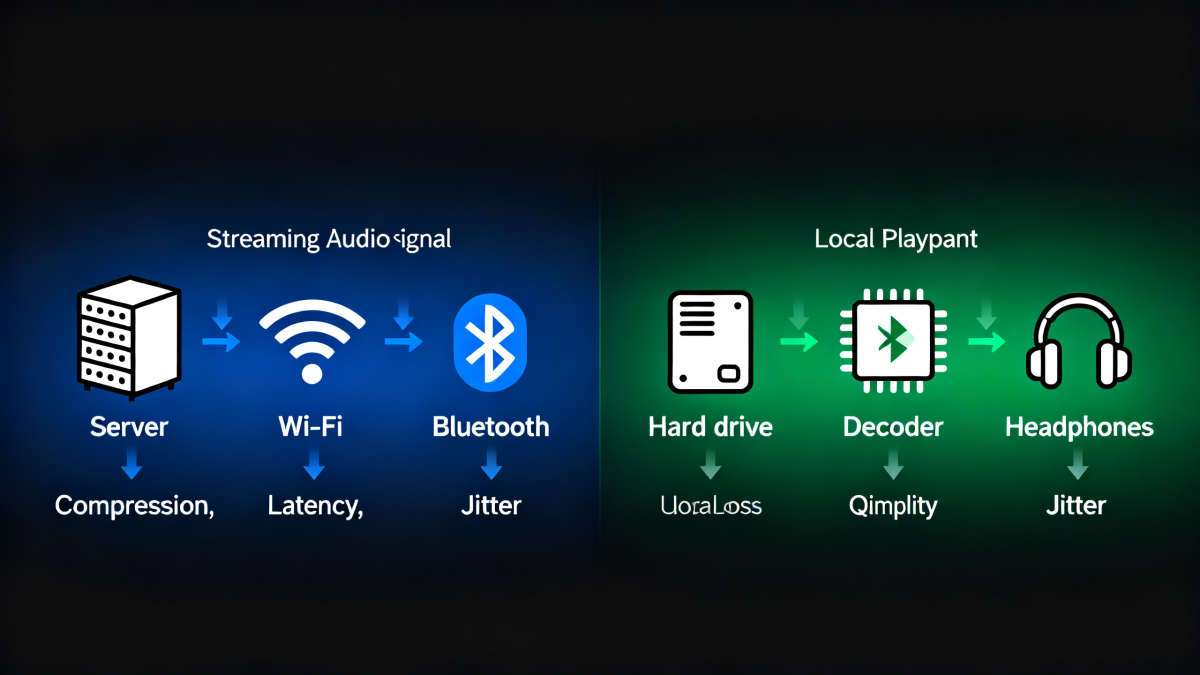
Streaming's "lossless" often stops at the server. For data to reach your ears, it must traverse a complex "loss chain." Bluetooth has bandwidth ceilings; even the latest LDAC or aptX Lossless max out near 990kbps, barely carrying 24bit/96kHz audio, and will automatically lower the bitrate if the signal is unstable. Wi-Fi casting also has compromises; for example, AirPlay 2 sometimes downgrades to lossy AAC (256kbps) during multi-room sync. System-level resampling (SRC) forces 44.1kHz audio to 48kHz, introducing subtle distortion. Clock jitter makes data packet arrival times unstable, leading to time-axis deviations when the DAC reconstructs the waveform.
Every compromise steals a bit of the music's "soul." As we analyzed in Why We Still Download FLAC in the Streaming Era, FLAC files' "bit-perfect" nature ensures that every bit from disk to decoder is restored exactly.
With locally played FLAC files, the decoder reads data directly from the hard drive, skipping the entire transmission chain, achieving the most direct signal path. A 24bit/192kHz master-quality source can be hundreds of MBs in size, with information density several times that of CD quality. On an excellent playback system, this difference translates into amazing detail retrieval, airiness, and presence.
Trap 3: Algorithmic Recommendations and Privacy Concerns
Streaming algorithms are getting smarter, but also more homogenized. The platform pushes what you listen to. Seemingly considerate, it actually traps you in an "information cocoon." Those old songs that grew up with you, those niche but precious voices, are slowly drowned out by massive amounts of new songs. Your music experience becomes increasingly passive, increasingly defined by algorithms.
Not to mention privacy issues. Your listening data is comprehensively tracked by platforms; every play count, skip moment, and even mood fluctuation becomes raw material for commercial analysis. You lack a private personal space, a corner that belongs only to you and the music.
A local music library is your private territory. No algorithmic interference, no data monitoring. You can rummage through those old songs as you please, rediscovering albums you once ignored. This sense of initiative, similar to the ritual of flipping through records in a shop, is something streaming cannot offer.
2. Five Reasons to Return to Local Music
Reason 1: True Ownership and Eternal Certainty
Ownership is a profound psychological need. When you buy a vinyl record, you own not just a plastic disc, but a physical carrier of history. You can touch its texture, flip through the lyrics booklet, and feel the ritual of the needle dropping.
Downloading local music is rebuilding this sense of ownership in the digital realm. You are no longer just "accessing" a data stream, but placing a complete digital copy of that music into your private storage space. You can edit perfect tags for it, embed high-definition covers, and organize it into a carefully designed folder structure.
This certainty is especially precious in a digital age full of uncertainty. It means that ten, twenty years from now, when you want to listen to that old song again, it will still be there, sound quality intact, silent to no copyright changes.
Reason 2: Ultimate Sound Quality, A Zero-Compromise Listening Experience
For audiophiles, music producers, or any deep user who pursues sound quality, the "bit-perfect" characteristic of local FLAC playback is irreplaceable. From hard drive to decoder, the signal path is the shortest, every bit is exactly restored, with no compression algorithm trade-offs, no transmission protocol compromises.
A 24bit/192kHz master-quality source can be hundreds of MBs, with data volume several times that of CD quality (16bit/44.1kHz). This information density, on an excellent playback system, translates into amazing detail retrieval, airiness, and presence. You can hear the lingering tone of guitar strings, the emotion in a singer's breath, the spatial depth behind the string orchestra.
This is a promise that streaming cannot fully fulfill within existing technical frameworks.
Reason 3: Listen Anytime Offline, No Network Restrictions
Signal cuts in the subway, flight mode on planes, zero network coverage during mountain trips—in these scenarios, the "infinite library" of streaming collapses instantly. Although most platforms offer caching, it requires planning, takes up a lot of phone storage, and has time limits.
Local music is always online. No network needed, no data usage, no stuttering or interruptions due to signal fluctuations. It's right there in your hard drive or phone storage, waiting for your summons. This stability is something streaming cannot fully guarantee.
Reason 4: Digital Curation, Rebuilding a Deep Relationship with Music
The process of organizing a local music library is itself a deep musical journey. You need to edit tags, embed covers, and categorize for each song. This isn't tedious labor, but a form of "curation"—you are no longer a passive consumer of music, but its guardian.
Every song has a story. It might have accompanied you through a summer, been the soundtrack to a trip, or a gift from someone. When you organize these files yourself, you are reconnecting with those memories. A local music library is not just a pile of data, but a museum of your musical memories.
This difference of active exploration vs. passive recommendation lets you regain control of your music taste. You are no longer defined by algorithms, but define music yourself.
Reason 5: Hybrid Mode, Finding Balance Between Convenience and Reliability
Having said all this, I must emphasize one point: returning to local music does not mean completely abandoning streaming. Streaming has its irreplaceable value: the convenience of exploring new music, the possibility of discovering niche artists, the lightness of needing no storage space.
A more pragmatic approach is a "Local + Streaming" hybrid mode. Use streaming to discover and explore; when you meet something you truly like and want to keep forever, download it locally. Localize your core collection, use streaming for daily exploration. This way, you enjoy convenience while guarding certainty.
3. Practical Guide: How to Quickly Build Your Local Music Library?
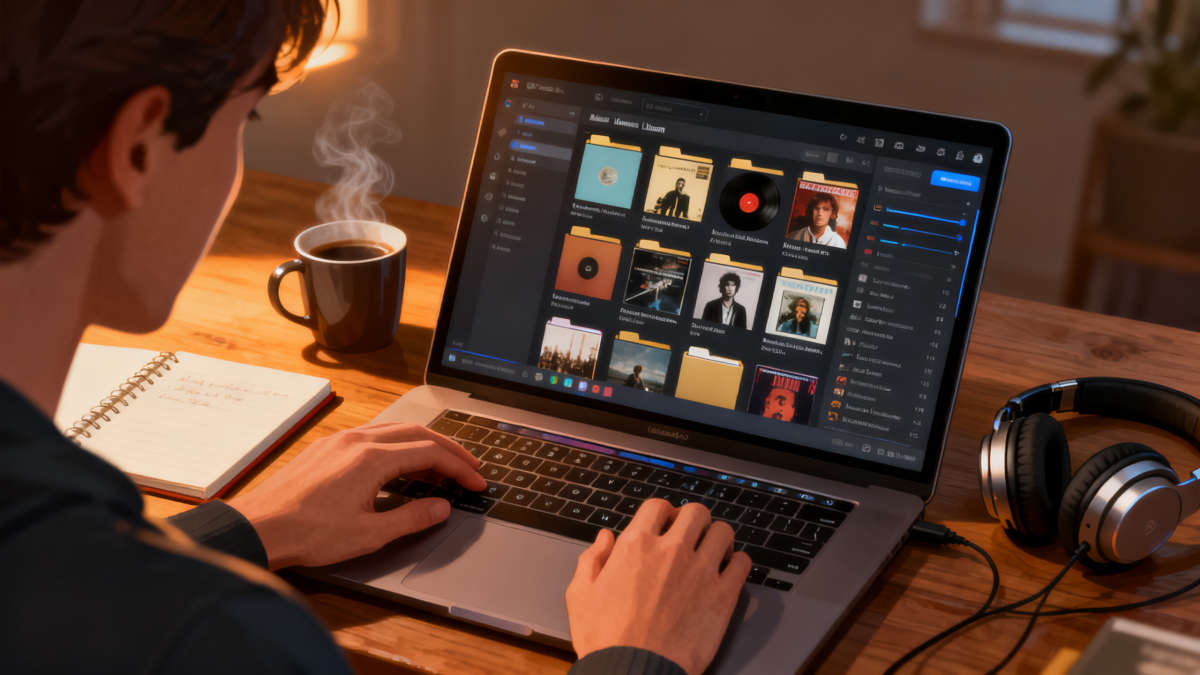
If you've been persuaded and decided to build a local music library for yourself outside of streaming, the next question is: how to start? This process might sound a bit technical, but once built, it will bring you long-lasting satisfaction and a sense of control. Spend 2-3 hours, and you can build a basic music library framework.
Step 1: Get High-Quality Sources (Legal Channels)
The prerequisite for building a high-quality music library is obtaining legal sources. Here are some reliable avenues:
Professional Digital Music Stores: Platforms like HDtracks, Qobuz, Bandcamp offer true 24bit/192kHz master-quality FLAC files. Prices are usually higher than physical CDs, but the sound quality and convenience are worth it.
CD Ripping: If you have a large CD collection, use professional software like Exact Audio Copy (EAC) for "exact extraction" to generate perfect FLAC copies. Each CD rip takes 5-10 minutes, a one-time investment for permanent preservation.
Streaming Platform Downloads: Some platforms (like QQ Music Luxury Green Diamond, NetEase Cloud Music Vinyl VIP) allow downloading lossless files. But note, these files usually have DRM protection and can only be used in the platform's own player, not true "ownership."
Traps to Avoid: "Lossless resource packs" from unknown sources often have messy tags, uneven sound quality, and may even contain malware. For your device security and sound quality assurance, please stick to legitimate channels.
Step 2: Organization and Tag Management (Making the Library "Smart")
A pile of FLAC files with messy filenames isn't a music library, just a data heap. A real music library should be easy to search, browse, and appreciate.
Standardized Folder Structure: Establish a clear hierarchy, for example:
Music Library/
  └─ Artist Name/
      └─ [2020] Album Name/
          ├─ 01 - Song Name.flac
          ├─ 02 - Song Name.flac
          └─ cover.jpg
Recommended Tools:
- MusicBrainz Picard: Identifies songs via audio fingerprinting, automatically matches album covers, release dates, and artist info, and writes MusicBrainz IDs (equivalent to a song's "digital ID"). Free, open-source, cross-platform.
- Mp3tag: Classic batch tag editor, supports regex replacement and online database queries. Suitable for renaming and tag unification of large numbers of files.
- Music Tag (Domestic Software): Excellent support for Chinese songs, can automatically match covers and lyrics from domestic music platforms.
Embed HD Covers and Lyrics: Use these tools to embed LRC format lyrics into audio files, so they display synchronously on any player that supports lyrics. Cover images should be at least 1000x1000 pixels HD.
Step 3: Choose Player and Management Tools
An excellent player not only plays music but also helps you better manage and discover music.
Desktop Player Recommendations:
- Windows: MusicBee (Comprehensive, Free), Foobar2000 (Minimalist and infinitely customizable via plugins), Roon (Audiophile level, ~$699 lifetime or $14.99/month)
- macOS: Audirvana, Swinsian, VOX
- Linux: Clementine, Strawberry
Mobile Solutions:
- iOS: Doppler, Cs Music, VOX
- Android: Poweramp ($5.99 one-time), Neutron, USB Audio Player PRO
Private Music Server (If you want to access your home music library anytime, anywhere):
- Navidrome + Symfonium/Amperfy: Lightweight open-source, runs on NAS or old PC, remote access via mobile app.
- Plex + Plexamp: One of the best music player app experiences, modern interface, supports sonic analysis and smart mixes.
- Jellyfin: Open-source free, similar functionality to Plex.
Step 4: Backup Strategy (3-2-1 Rule)
Once your music library is built, it becomes your digital asset. Remember to follow the 3-2-1 Backup Rule:
- 3 Copies: One on computer, one on NAS, one on portable hard drive.
- 2 Media Types: Hard drive and Cloud (e.g., encrypted backup on Google Drive or iCloud).
- 1 Off-site: Ensure one copy is kept off-site (e.g., office or friend's house) to prevent local disasters.
Periodically check the integrity of backups to ensure smooth recovery when needed. Remember: hard drives fail; no backup means no ownership.
4. Conclusion: Guard Your Music Island in the Streaming Torrent
Choosing local music, you choose not just an audio file, but certainty.
Streaming is a torrent; it's convenient, rich, and always flowing. But a torrent also means uncertainty—songs here today might disappear tomorrow. Everything you build on it is based on the platform's goodwill.
A local music library is an island. It's small, but solid. It won't disappear due to copyright changes, won't fall silent because a platform goes under, won't change due to algorithmic adjustments. It sits in your hard drive, quietly waiting.
On this island, there are no compression algorithm trade-offs, no smoke from copyright wars, only the most primal, certain connection between you and music. Every song is hand-picked, organized, and saved by you; they are not products of algorithmic recommendation, but the physical manifestation of your musical memories.
In 2026, in this world full of uncertainty, building a local music library for yourself is a way to fight digital oblivion. It reminds us that music is not just background noise, not just a commodity recommended by algorithms; it can also be an art that needs to be taken seriously, preserved completely, and enjoyed privately.
Start now, build a local backup for your favorite 100 songs.
Don't let your ears be displaced. In the torrent of streaming, keep a music island that belongs to you.
🎧 Ready to Return to a Pure Music Experience?
Let iPlayer be the home for your lossless FLAC collection and start your high-fidelity auditory journey.
- 🔊 Exclusive Mode, Pursuit of Ultimate Sound Quality
- 📂 Powerful Folder Management
- ✨ Pure Interface, Return to the Essence of Listening