
MP3 320kbps vs FLAC: The Ultimate 2026 Audio Quality Guide
Is MP3 320kbps as Good as FLAC?
Introduction: The Eternal Audio Format Debate
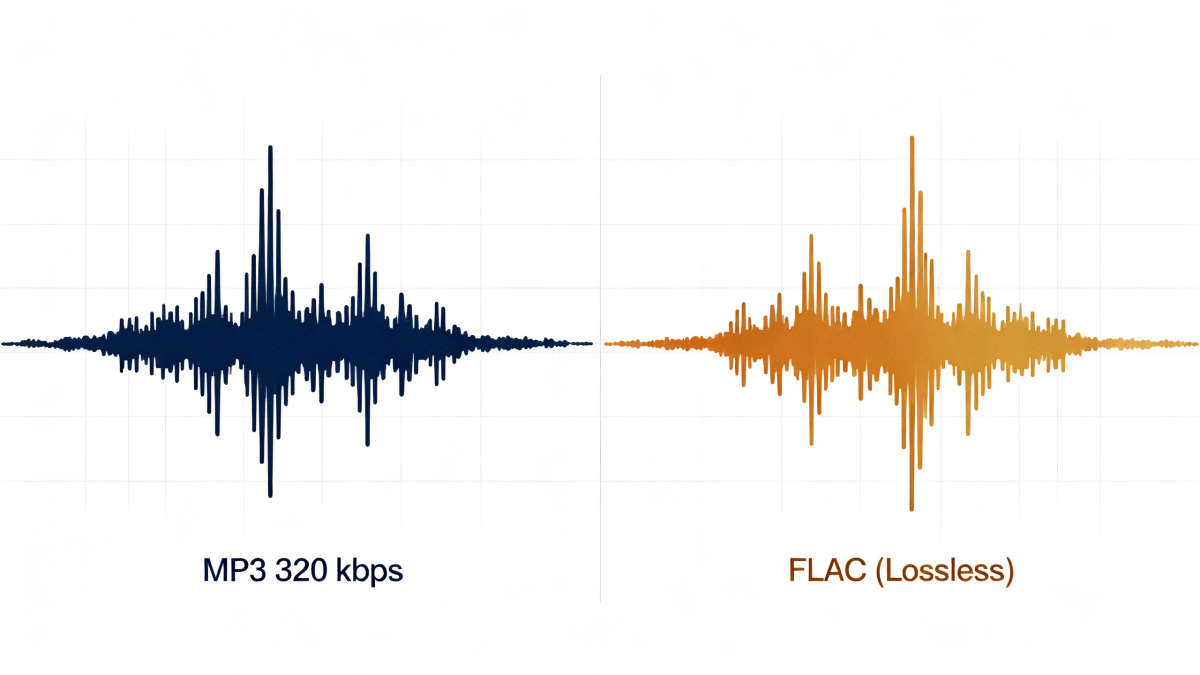
The short answer: MP3 320kbps is perceptually indistinguishable from FLAC for the vast majority of listeners, even those using high-end equipment. But that technical reality doesn't make the choice simple.
FLAC (Free Lossless Audio Codec) preserves every bit of the original recording - a perfect digital clone. MP3 at 320 kbps, the format's maximum bitrate, uses psychoacoustic algorithms to discard data your ears are unlikely to detect. On paper, one is mathematically superior. In practice, decades of blind listening tests show that most people - including professional audio engineers - cannot reliably tell them apart.
But the debate persists. Storage costs and archival needs matter. So does equipment quality - and even the peace of mind from owning "perfect" files. This guide cuts through the audiophile tribalism and marketing noise to give you the data you need to choose the right format for your situation.
Technical Specifications: Understanding the Difference
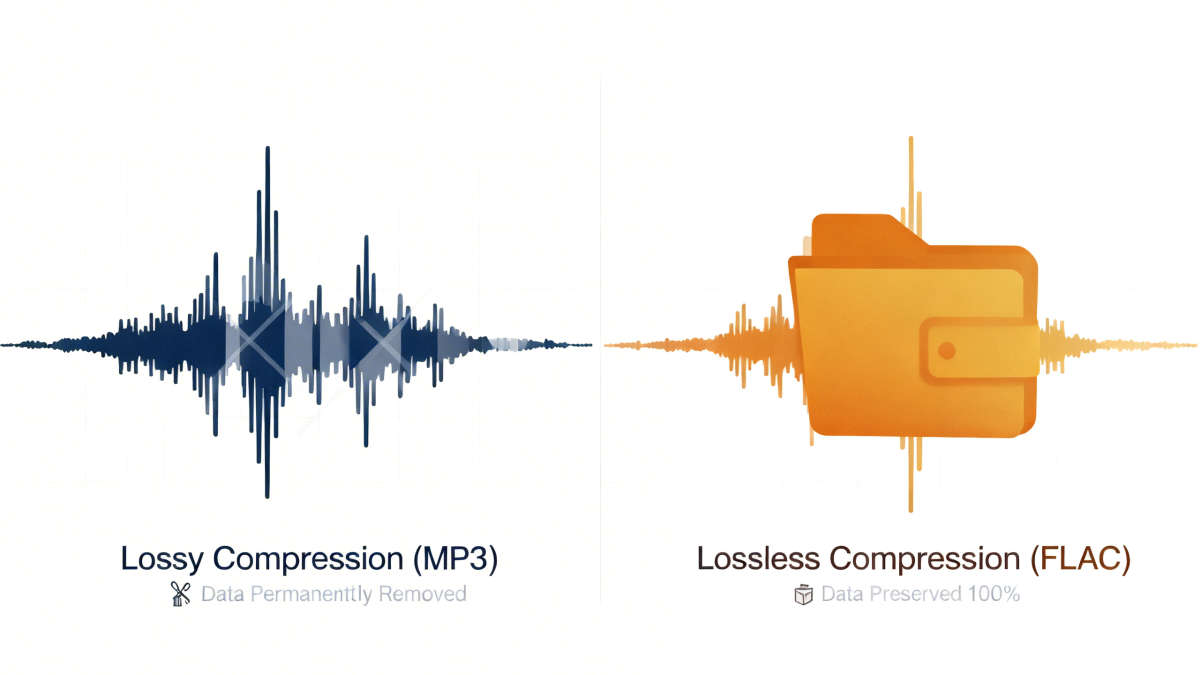
MP3 is lossy - it permanently discards audio data deemed inaudible. FLAC is lossless - it compresses like a ZIP file, retaining every bit of the original. That fundamental distinction shapes everything else.
The Numbers That Matter
Both formats start from the same source: uncompressed CD-quality audio at 1,411 kbps (16-bit, 44.1kHz). Here's how they handle it:
| Specification | MP3 320 kbps | FLAC (Lossless) |
|---|---|---|
| Compression Type | Lossy (psychoacoustic modeling) | Lossless (mathematical compression) |
| Bitrate | Fixed 320 kbps | Variable, typically 700–1,000 kbps |
| Compression Ratio | ~4.4:1 (reduces size by 77%) | ~1.5:1 to 2:1 (reduces size by 30–60%) |
| File Size (5-min song) | ~11.5 MB | ~25–40 MB |
| File Size (per minute) | ~2.4 MB | ~5–9 MB |
| Frequency Response | Low-pass filter at 16–20 kHz | Full spectrum (up to 22 kHz for CD-quality) |
| Data Recovery | Impossible (data is gone) | Perfect (bit-for-bit identical) |
A FLAC file is roughly 2 to 4 times larger than a 320 kbps MP3 for the same track.
How MP3 Compression Works
MP3 encoders use psychoacoustic modeling to exploit limitations in human hearing:
- Masking: Loud sounds make quieter nearby frequencies inaudible. The encoder strips them.
- Frequency cutoff: Most encoders apply a low-pass filter around 16-18 kHz, removing the upper harmonics that few people can hear.
- Temporal masking: Sounds immediately before or after a loud transient are often masked. The encoder reduces their data.
Once this data is removed, it's gone forever. Converting an MP3 to FLAC doesn't restore it - you're just wrapping a lossy file in a lossless container.
How FLAC Compression Works
FLAC uses mathematical prediction algorithms to find patterns in the audio waveform and encode them more efficiently, similar to how a ZIP file works. No audio information is discarded.
- Compression levels (0-8): These control encoding time and file size, not quality. A level 0 file and level 8 file sound identical. Level 5 is the industry standard.
- Variable bitrate: Simple passages (silence, pure tones) compress more. Complex orchestral sections require higher bitrates.
- Checksum verification: FLAC includes a fingerprint that allows players to detect file corruption.
- Hi-Res support: FLAC handles up to 32-bit depth and 655 kHz sample rates, making it the standard for high-resolution audio.
The Archival Difference
This is where the technical gap becomes practically significant. FLAC is future-proof. You can convert it to any format - MP3, AAC, Opus - without losing additional quality. When you convert MP3 to another format, you lose more quality, like making a photocopy of a photocopy.
For building a music library you'll keep for decades, FLAC is the safest bet if you want to avoid regretting your choice later.
The Listening Test Reality: What Research Shows
Technical superiority doesn't always translate to audible differences. This is where the format war gets interesting - and where science delivers a clear verdict.
The ABX Test Gold Standard
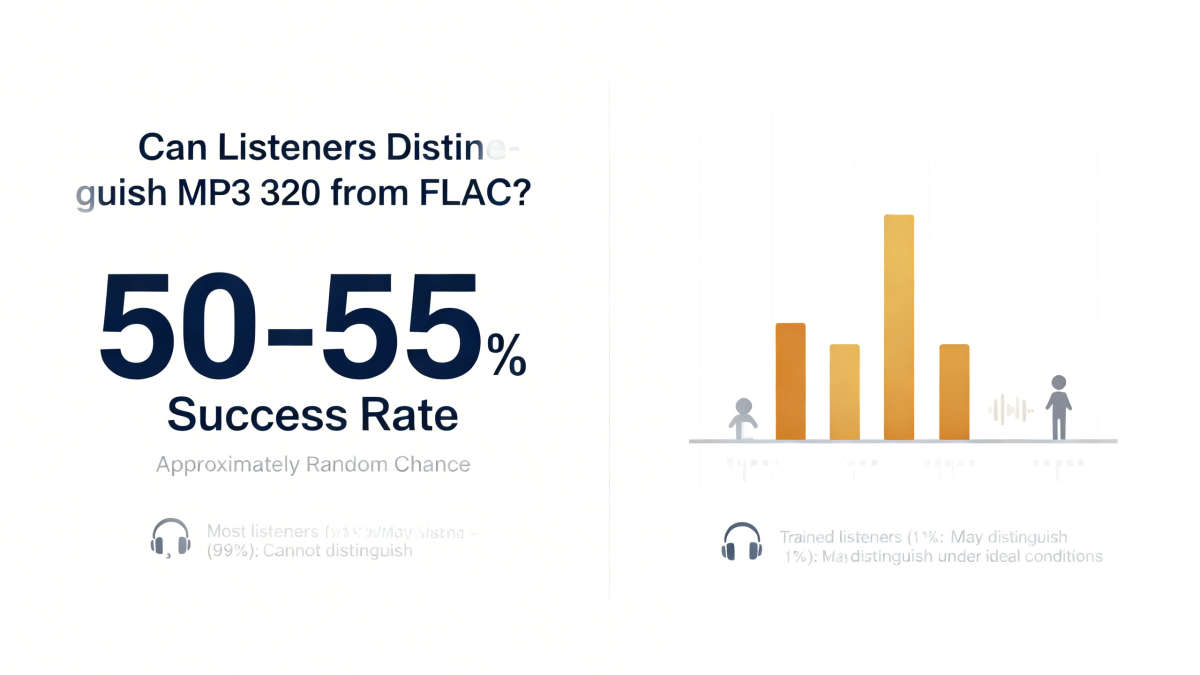
ABX testing is the audiophile community's most rigorous method for detecting audible differences. The listener is presented with three samples: A (reference), B (comparison), and X (unknown). The task is to identify whether X matches A or B. Success rates near 50% indicate random guessing - no real difference detected.
The results for MP3 320 vs. FLAC are humbling:
- Large-scale community tests on Hydrogenaudio show success rates hovering around 50-55% for 320 kbps MP3 versus lossless.
- A landmark 2007 study in the Journal of the Audio Engineering Society found that even trained listeners using high-end monitoring equipment could not reliably distinguish high-bitrate files from CD-quality audio.
- Research confirmed that while 128-192 kbps MP3s are easily identified, 256 kbps and 320 kbps results are statistically insignificant - listeners are essentially guessing.
When Differences Can Be Heard (The 1% Exception)
Under specific conditions, a small percentage of listeners with trained ears can detect MP3 320 artifacts:
- Killer samples: Certain sounds challenge lossy encoders (cymbal decay, reverb tails, fast transients, complex orchestral passages).
- Golden ear training: Audio engineers who've spent years learning to identify compression artifacts have an edge.
- High-end equipment: The difference is more likely to surface with open-back planar magnetic headphones or studio monitors in acoustically treated rooms. Consumer Bluetooth earbuds and car speakers mask the subtle losses.
- Age and hearing: Most adults over 30 experience natural high-frequency hearing loss. If you can't hear above 15 kHz, the MP3 encoder's high-frequency cutoff is irrelevant to you.
The Placebo Effect Is Real
Research highlights a critical finding: in sighted tests (where listeners know which file is FLAC), people consistently report hearing better 'detail,' 'soundstage,' and 'clarity.' In blind tests, those same listeners fail to identify the format.
This isn't a knock on audiophiles. Expectation bias is a well-documented psychological phenomenon. The knowledge that you're hearing 'perfect' audio genuinely enhances the subjective experience, even when the waveforms are functionally identical.
Storage, Workflow, and Practical Considerations
The technical and perceptual data tell only part of the story. Real-world usage introduces practical constraints that can tip the scales.
Storage Costs in 2026
Storage has become astonishingly cheap, but the gap still matters if you're managing a large library:
- 1,000-song library: MP3 320: ~11.5 GB | FLAC: ~30 GB
- 10,000-song library: MP3 320: ~115 GB | FLAC: ~300 GB
A 512 GB smartphone can comfortably hold 40,000+ MP3 320 tracks, but only ~15,000 FLACs. For portable devices with limited storage, MP3 remains the pragmatic choice.
The Bluetooth Reality Check
Here's an inconvenient truth: if you're using Bluetooth headphones or speakers (which most people are in 2026), the wireless codec is your limiting factor, not the source file.
Even with aptX Lossless or LDAC at maximum settings, you're re-encoding the audio for wireless transmission. The difference between starting with MP3 320 or FLAC becomes mostly irrelevant once Bluetooth enters the chain.
When MP3 320 Works (and When It Doesn't)
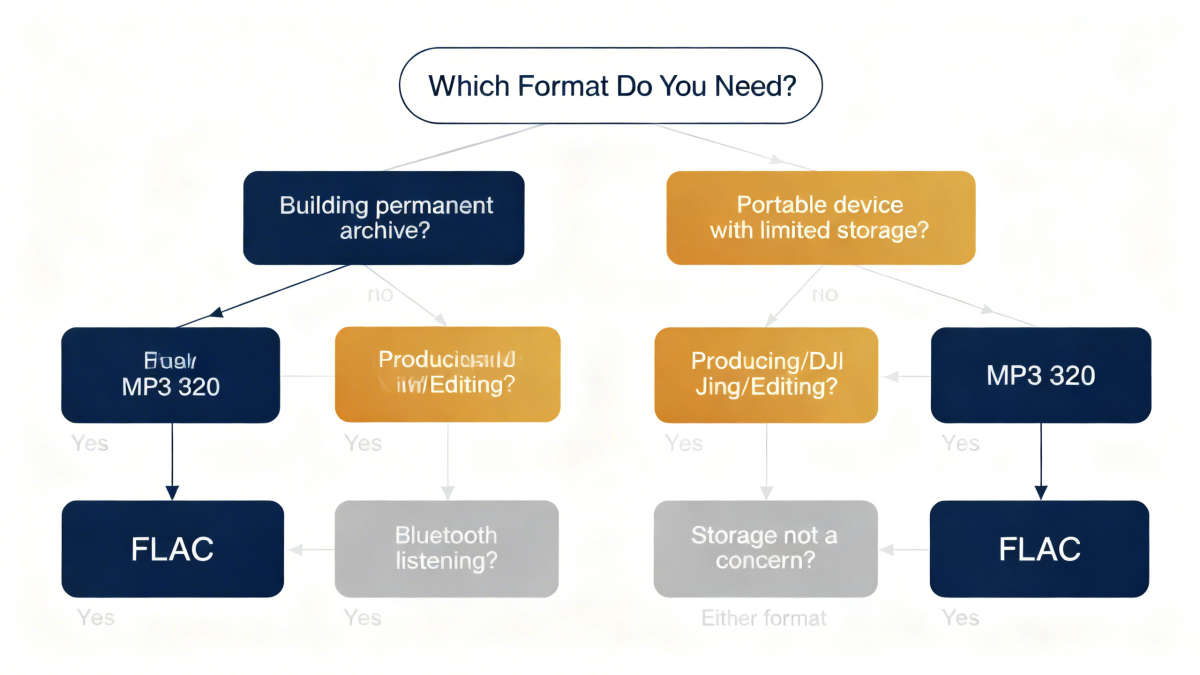
Choose MP3 320 When:
- Portability is priority: Loading music onto a smartphone or smartwatch.
- Bluetooth is your primary playback method: Wireless earbuds, Bluetooth speakers.
- You listen in noisy environments: Commuting, gym workouts, coffee shops.
- Compatibility is essential: Older car stereos or legacy devices.
Choose FLAC When:
- Archiving is the goal: Building a permanent library you'll keep for decades.
- You're producing or DJing: Professionals need lossless masters for editing.
- Critical listening sessions: Dedicated listening with high-end headphones in a quiet room.
- You care about technical perfection: Knowing you have bit-perfect files matters to you.
The Verdict: Which Format Should You Choose?
The data is clear: for everyday listening, MP3 320 is functionally equivalent to FLAC for the vast majority of people. Blind testing consistently shows that even trained listeners struggle to distinguish them.
The optimal strategy for most music lovers is both: maintain FLAC masters at home for archival security and convert to MP3 320 for mobile devices. Modern hard drives are cheap enough that you don't have to choose between quality and convenience.
🎧 Experience Ultimate Sound Quality with iPlayer
Whether you choose MP3 or FLAC, iPlayer's Exclusive Mode ensures you hear every detail your file has to offer.
Download iPlayer Now